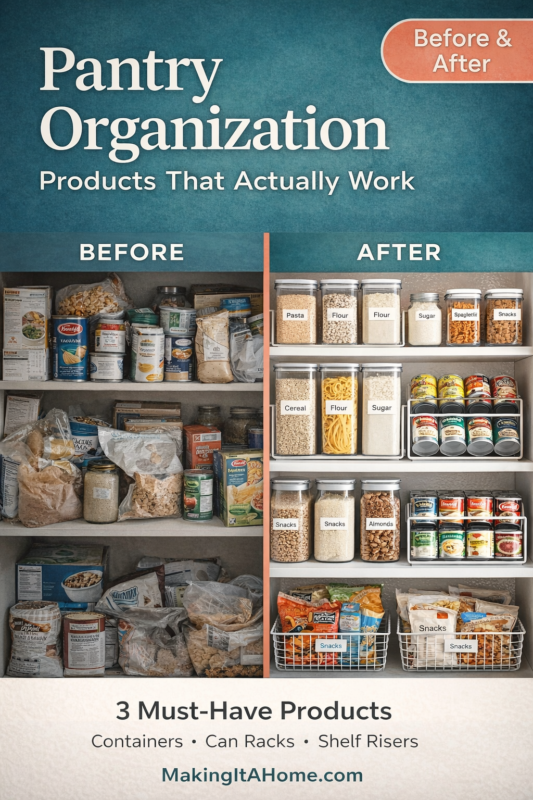
The pantry looks like a disaster zone. Cans rolling around, half-empty cereal boxes taking up entire shelves, pasta in three different places, and there’s probably a fourth container of cinnamon somewhere hiding behind those mystery boxes.
Here’s the frustrating part: organizing has been attempted before. Containers were purchased, maybe some shelf risers, everything got put away neatly… and within two weeks it was chaos again.
The problem wasn’t effort. The problem was buying the wrong products for the actual space and habits in that household.
Not all pantry organization products work in all pantries. A deep, narrow pantry needs different solutions than a wide, shallow one. A family of five organizing bulk items needs different containers than a couple organizing specialty ingredients.
This guide helps figure out what’s actually needed based on specific pantry situations, so the right products get bought once instead of accumulating organizational clutter.
Before You Buy Anything: The Pantry Audit
Open your pantry right now. Seriously.
What’s actually in there? Not what you think should be there, but what’s actually taking up space.
For most people, it’s:
- Canned goods (soups, beans, tomatoes, vegetables)
- Dry goods in boxes (pasta, rice, cereal)
- Baking supplies (flour, sugar, baking soda, chocolate chips)
- Snacks (chips, crackers, nuts, granola bars)
- Oils, vinegars, and cooking liquids
- Spices (probably way too many)
Look at the proportions. If you have 30 canned items but only three boxes of pasta, you need more can storage than pasta storage. Obvious, right? But most people buy equal amounts of everything and wonder why it doesn’t work.
The golden rule: Organize for what you actually have, not what Pinterest pantries look like.
The Three Pantry Types: Which Is Yours?
Your pantry probably falls into one of these categories. Each needs different solutions.
Deep Narrow Pantry
- The problem: Items in back are invisible. You buy duplicates because you can’t see what you have.
- What works: Pull-out solutions and tiered risers that bring items forward.
- Skip: Wide bins that push stuff deeper.
Wide Shallow Pantry
- The problem: Things spread out horizontally and lose structure.
- What works: Bins and dividers that create zones and boundaries.
- Skip: Deep storage containers that waste your shallow space.
Tiny Apartment Pantry
- The problem: Every inch matters. No room for bulky organizers.
- What works: Slim, stackable solutions that maximize vertical space.
- Skip: Full pantry systems designed for walk-in pantries.
Start Here: The Three Essentials
These three categories will transform your pantry. Everything else is optional.
Clear Airtight Containers for Dry Goods
Why: See what you have instantly, food stays fresh, stacks uniformly without weird gaps.
What to look for:
- Actually airtight (not just lids sitting on top)
- Square or rectangular (round wastes space)
- Stackable with flat tops
- Multiple sizes in one set
Reality check: Don’t decant everything. Start with bulk items you buy frequently—flour, sugar, rice, pasta, cereal. Specialty ingredients can stay in original packaging.
Vtopmart Airtight Food Storage Containers – Standard for a reason. They seal, stack perfectly, include labels. Get the variety pack.
How many? Count your bulk items. Most households need 8-12 containers total.
Can Organizers
Why: Cans roll and hide. Organization makes them visible and grabbable.
What to look for:
- Tiered or stepped (see back rows)
- Fits your shelf height (measure first—you need 12-14 inches clearance)
- Sturdy construction
- Front access
SimpleHouseware Stackable Can Rack – Stepped design, holds 36 cans. Perfect for most households.
DecoBros Supreme Stackable Can Rack – For larger families or bulk buyers. Adjustable dividers.
Which one? Under 30 cans? SimpleHouseware. More than that? DecoBros.
Shelf Risers
Why: Double your shelf space by creating a second level. Back items stay visible.
What to look for:
- Sturdy (holds cereal boxes and jars)
- Fits your shelf depth
- Metal or heavy-duty plastic
Reality check: Best for shorter items—spices, jars, small boxes. Don’t stack tall items on them.
Simple Trending Expandable Stackable Organizer – Expandable width fits different shelves. Use for spices, jars, small boxes.
How many? One per chaotic shelf. Start with one, see if you need more.
Nice-to-Have Upgrades
Once basics are handled, these help but aren’t essential.
Lazy Susans – Worth it for deep corner shelves with oils, vinegars, condiments. Skip for narrow spaces. mDesign 9-inch Lazy Susan fits most pantries.
Door Organizers – Great for spices and flat packets that get lost. Not for heavy items. Skip if your door can’t handle weight.
Labels – Everyone knows where things go. Use a label maker or changeable labels (better than permanent for most people).
Don’t Waste Money On These
40 matching containers – Buy a variety pack, see what you use, then buy more of those sizes.
Baskets for everything – They hide contents. Use only for non-food items like paper products.
Tiny specialty organizers – Single-serve butter dishes, bagel bins. They create clutter.
Stackable bins without handles – Can’t pull them out to see what’s in back. Same problem you’re solving.
The Organization Process
Products don’t work without a system.
- Empty everything – See the full space
- Toss expired items – Be ruthless
- Group like items – Shows what storage you need
- Measure shelves – Height, width, depth. Write it down.
- Install organizers – Structure first (can racks, shelf risers)
- Decant bulk items – Only frequent purchases
- Label everything – Even “obvious” things
- Create zones – Baking, breakfast, snacks. Keep categories together.
Keeping It Organized
Sunday Reset (5 minutes weekly): Move older items forward, toss expired, wipe one shelf.
One-In-One-Out: Check what you have before buying more.
FIFO System (First In, First Out): New items in back, older forward.
Habits matter more than products. Best containers won’t help if you shove items randomly.
What’s Next?
Pantry organized? Tackle the next problem area—kitchen drawers or under the sink. Create one working system at a time. When this becomes automatic, move on.
Hey Homie,
Pantry organization isn’t about Pinterest perfection. It’s about finding what you need, not buying duplicates, and not letting food expire invisibly.
Buy products that solve YOUR problems. Deep pantry? Pull-out solutions. Too many cans? Tiered organizers. Bulk dry goods? Airtight containers.
Start with basics, see what works for your habits, add more if needed.
Pin this